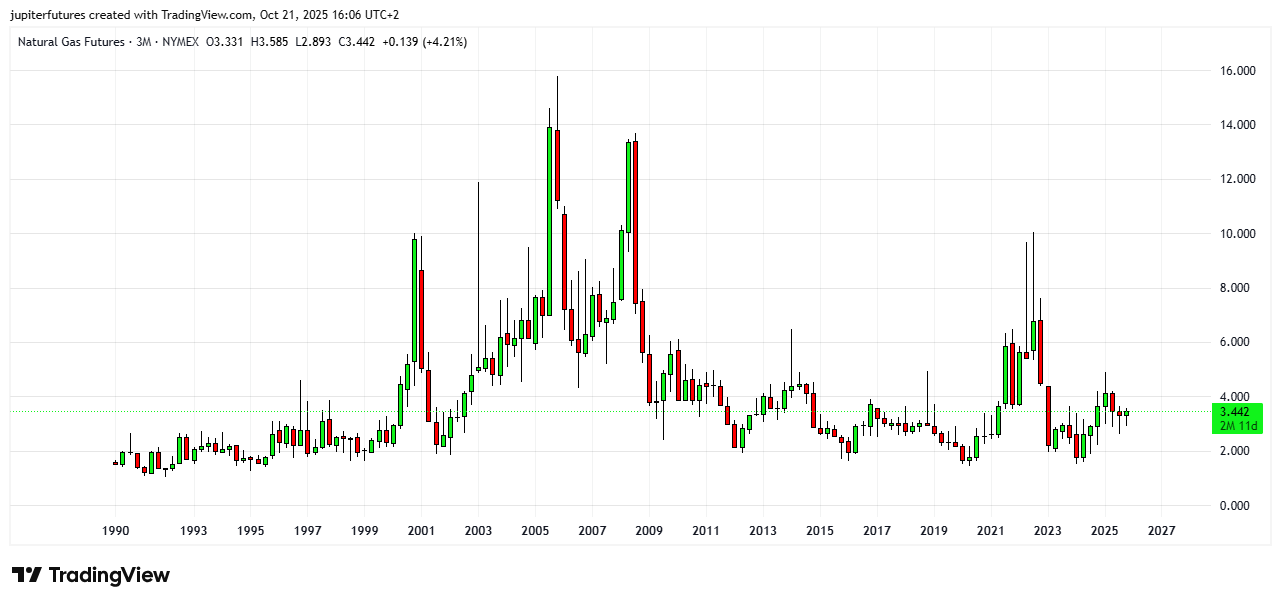
Henry Hub Natural Gas (front‑month NG futures) is still in a broader bullish phase on the daily chart, but it is currently in a corrective / consolidating zone after a very sharp rally, with elevated volatility and key support just below current prices.
1. Trend and moving averages (daily)
-
Price context: NG is trading around the $3.75 USD/MMBtu on the front contract, after a strong run from $3.00 (and below) in Q4, 2025.
-
All the key moving averages (20, 50, 100, and 200‑day) on the Feb ’26 futures contract are below the current price, which signals a strong upside bias when you look across the curve, though the front month futures have corrected more.
-
On the NatGas CFD / spot‑linked charts, the 100‑day SMA is crossing above the 200‑day SMA, forming a medium‑term bullish “golden cross”, with both longer MAs below current spot price and acting as dynamic support on dips.
Interpretation: Structure is bullish on a multi‑week/multi‑month view, but shorter‑term price is digesting gains and testing support within that uptrend.
2. Momentum, oscillators, and volatility
-
On the Feb ’26 contract, stochastic readings are in the mid‑90% area and RSI is in the low‑80s on multi‑day lookbacks, confirming that the recent spike pushed the contract into overbought territory.
-
For the front‑month / CFD, RSI and stochastic have cooled back toward the middle of their ranges, consistent with a consolidation phase after the surge, giving “room” for a fresh move in either direction while the broader structure stays bullish.
-
ATR and volatility metrics have ramped up sharply: 9‑day ATR is about 0.65 (about 10% of price), versus a 50‑day ATR closer to 0.23 (3% of price), and historic volatility on the short window is above 150% annualized.
Interpretation: NatGas has high volatility and just came off an overbought spike; we’re now in larger consolidation where daily swings of $0.30–0.60 USD per day are common.
3. Support and resistance levels (daily)
From the current level of about $3.75:
-
Immediate support level for NG:
-
Rising trend‑line support from late‑2024 lows comes very close to current price, near $3.75, and this line has repeatedly attracted dip‑buyers in recent months.
-
Below that, support zone appears at $3.60, which is a prior consolidation zone and also the first downside target if the trend line fails.
-
-
Deeper support level for NG:
-
If $3.60 breaks decisively, the next downside zone is near $3.20, where the market based out before the latest rally; this aligns with recent EIA spot prints near 3.25 and the prior pullback area on the daily chart.
-
-
Near term resistance for NG:
-
First resistance is the recent high and congestion band around $4.75–5.10, defined by Fibonacci extension targets (38.2% and 50% extensions) from the prior move.
-
$5.50 region (61.8% extension) is a stronger resistance cluster, and a more aggressive upside extension projects towards about $6.60 if bulls fully reassert control.
-
Interpretation: NG Bulls need to hold the price level of $3.75–3.60 to defend the uptrend; bears would gain control only on a sustained break below this band.
4. Price structure and pattern
-
Since late 2024, NG has been respecting a rising daily trend line, producing a series of higher lows while oscillating in wide swings, consistent with a bullish channel.
-
The current pullback is taking place right at that rising support, so the immediate tactical battle is whether this acts as yet another launchpad for a leg toward the $4.75–5.10 area, or whether the trend line finally breaks and opens room toward $3.60 and lower.
-
The recent spot move from $4.37 down to $3.25 within a few days shows how weather and storage news can abruptly unwind overextended rallies; that keeps the risk of sharp short‑term reversals high even within the medium‑term uptrend.
Interpretation: A sharp breakdown below $3.00 can create a deeper correction to $2.50 before supply shock kicks in due to closure of dry gas wells, which has higher break-even price compared to wet gas wells.
5. Trading implications (daily timeframe)
Not trading advice, just how a technical trader might frame it:
-
Bullish bias as long as price holds above the rising trend‑line / $3.60 area, with upside swing targets around $4.75-5.00, then $5.50.
-
Losing the trend line and closing below $3.60 would shift focus to the $3.20 zone and potentially flatten out the medium‑term bullish thesis into a broader range or deeper retracement.
Very important Note: Given the ATR around $0.40–0.60 and high volatility, position sizing and stop placement need to assume intraday swings of 5-10% are possible without breaking the larger pattern.